

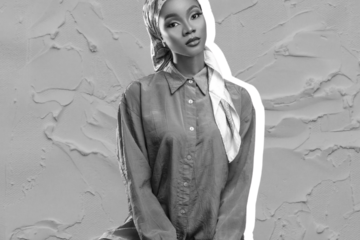
One-third of The Honest Scholars, Izdihar Bailey-Basayeva is a historian whose aesthetic is shaped and inspired by Russian history, military history, Eastern European folk dresses and Edwardian blouses. She’s an American convert of Balkan heritage, and goes by the moniker “Lady Izdihar” on social media. In an exclusive discussion with Modestish, she tells us about her prized military accessories and Russian square scarves, and offers some valuable advice for women seeking to dress modestly.
Describing her personal style as “selectively historic Eastern European peasant with a militant flare,” she encourages us to refrain from letting others’ opinions and expectations dictate our fashion choices, and believes that modest fashion is not synonymous to prudishness. She also reminds us that modesty is rooted in cultures across the globe – and that no single demographic has a monopoly over “Muslim” fashion.
1. What attracts you to the idea of dressing modestly? Was there any personal turning point in your life that inspired you to embark on a more modest lifestyle?
I would say that my main attraction to dressing modestly (other than my faith) are my interests in Eastern European/Russian history as well as military history. Historically people dressed modestly for practical, cultural and religious purposes; wearing a headscarf to keep your hair out of your face, wearing long skirts to protect your legs, etc. I feel that dressing modestly reconnects me to my culture and heritage that my family has lost over the years, this way of dress is my connection to that, a sense of belonging. Growing up, my family was very alternative and open minded, there really weren’t any rules; want a tattoo (I’m the only family member without one)? sure. How about a mini skirt? You’ve got it! That coupled with my height (I’m 5’10”) made it difficult to dress modestly, especially with what little money I had.
When I converted to Islam in 2014 at the age of 19, modesty became a new priority for me, but I didn’t have the money to reinvent my wardrobe, so there was a slow transitional period where I would try to dress modestly as I could, it was only after a few years that I had enough clothes to dress modestly and wear hijab full time
2. Would you say modest fashion is a “religious” movement, a “style” movement, or both/neither?
As a historian, I’d have to say modest fashion is historical! Every people group, every region of the world throughout history had a form of modest dress or head covering at some point.
I also feel that in the west now there is an expectation for women to dress immodestly, to the point where you will get more questions as to why you aren’t showing your body then why you are. So it’s also a liberation movement, liberation from an expectation for us to show our body to whoever is passing by, dressing modestly gives us the power to choose who does and does not get to see that.
3. How do you describe your personal style?
My style is definitely inspired by history and my exploration of cultural heritage. I take a lot of inspiration from the Folk dress of eastern Europe, I incorporate a lot of square scarves (called Platok) from the region, now usually only worn by older women and women who might do so for the practicality of keeping hair out of their face. Now that “western” fashion is more preferred, local styles are becoming less common and fading into obscurity. I love dresses and blouses inspired by the Victorian and Edwardian eras, they are modest and intricate, high-necked and frilly. I also am inspired by military history: the bold and structured cuts of uniforms. Many of my accessories are military surplus; my bags, belts and badges. SO how do I combine that into a “style”? Maybe “selectively historic Eastern European peasant with a militant flare.”
There is a term for dressing inspired by history, some call it “historybounding” defined as, “the act of incorporating historical or history-inspired clothing into your day-to-day fashion choices”
4. How has shopping for modest fashion changed over the past decade, in your experience?
I can only speak from my 6 years of personal experience dressing modestly, after converting to Islam I went from losing my sense of personal style to trying to dress like other Muslims I knew, to regaining my personal style and how to incorporate that modestly. I started to be less worried about what I wore and if people would think it was modest.
Modesty as a Muslim is too often equated to Arab cultural dress, I took inspiration from my own cultural background, rather then what’s popular with other Muslims. I had no connection to Arab culture, yet I saw many other converts lose themselves in the expectations of cultures that shouldn’t be the standard, cultures masquerading themselves as Islam. Modest fashion exists all over the world as does Islam, so I encourage others to take inspiration from around the world and their own family history.
5. Your favourite place to shop (online or store) and your most recent buys from there?
Vintage/thrift stores and ETSY! Etsy is a life saver for those interested in historical and folk dress. Most recently I got a vintage Laura Ashley dress from Etsy, I wore this dress in a recent reel I posted on Instagram where I explain what a “military map case” is and show what someone might keep in it.
I love vintage Laura Ashley dresses because during the 70’s and 80’s they took a lot of inspiration from modest cuts of the Victorian and Edwardian eras as well as prairie dresses. They can go for quite a bit of money because people collect them, but I think I got mine from someone who didn’t quite know what they had, as I paid very little!
6. Advice you would give to your 15-year-old self:
I think my 15-year old self was blissfully unaware, I’ve always been very inattentive to my surroundings and social expectations, even more so as a teenager so I really didn’t care what anyone thought and naturally wore purely what I enjoyed even if I looked ridiculous, I just wore what made me happy. So I would tell myself not to lose that, not to become paranoid about what others think, because the only opinion that matters is Allah’s.
7. What are some of the misconceptions about modest fashion, and areas you see for improvement within the modest fashion industry?
I think there’s a perceived correlation between modesty and prudishness which I don’t think is accurate. All clothing is a way of expressing yourself and your morals but it’s not quite as cut-and-dry as people might think, a lot of these assumptions are based on stereotypes. I think people also correlate confidence with showing off your body or that modesty is somehow less progressive. I think the fashion industry, if they intend on overproducing excessive amounts of clothing, should at least add more modest options to their variety. or people could shop second hand like I do and find plenty of modest options!
I’m not a fan of capitalism, in case you couldn’t tell.
8. Your advice for dealing with the “haram police” or fashion policing from critics on Instagram?
For the longest time I thought just blocking people sending hateful messages was the right thing to do. However, I recently had an incident where me blocking was perceived as “not listening to marginalized voices” which blew up and many negative assumptions were put on me.
Nobody is the gatekeeper to a religion. So when it’s a personal or religious matter, be content in your relationship with Allah, which does not need to be proven to others. Pray for those who think badly of you, they are likely projecting. But also take note, there’s always something to learn from others. Don’t focus on image and proving yourself, it’s a waste of energy and well-being.
9. What is the one garment in your closet that you’ll never part with and why?
My Russian square scarves (Platok) are very symbolic of the region. All of Eastern Europe, Russia and much of Central Asia wear this style of scarf in some way. It’s symbolic of the region my family came from, of the history I love and have dedicated my life to study and share, and it’s modest, so implementing these kinds of scarves into my personal style was the best decision I ever made and instantly make any outfit more “me”.
10. Finally, can you tell our readers a bit about The Honest Scholars?
The honest scholars are a trio of friends committed to collectivizing education and speaking truth to power. We are all scholars in our own right. Blair Imani is a historian and author who focuses on privilege & oppression, United States history: reconstruction, Great Depression, World War II, Civil Rights Movement and LGBTQ+ history. Ren Fernandez-Kim is a Forensic Anthropologist who focuses on Latin American History, Korean Folklore and Biology. And then there’s me, Izdihar Bailey-Basayeva: I’m a historian who focuses on Eastern Europe/ Post Soviet states, political geography, ethnography, vexillology, combatting Russophobia & political theory. Together the 3 of us make a great team to cover a large area of research and combat misinformation and the problematic way history has been taught up until now.
You can find us at the Instagram page @TheHonestScholars
Featured image courtesy of Lady Izdihar / Canva

Your style is so unique in comparison to
other folks I have read stuff from.
Thank you for posting when you’ve got the opportunity, Guess I’ll just book mark this web
site.