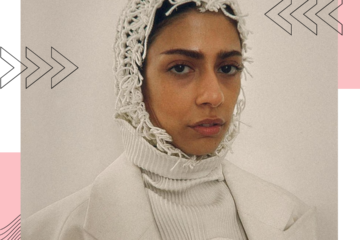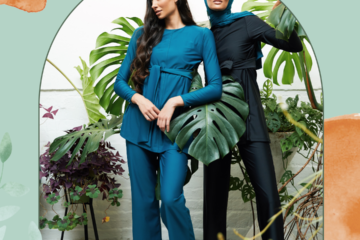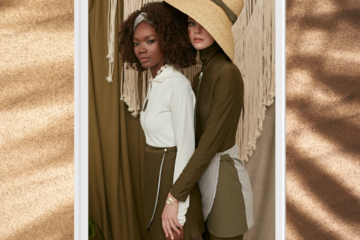

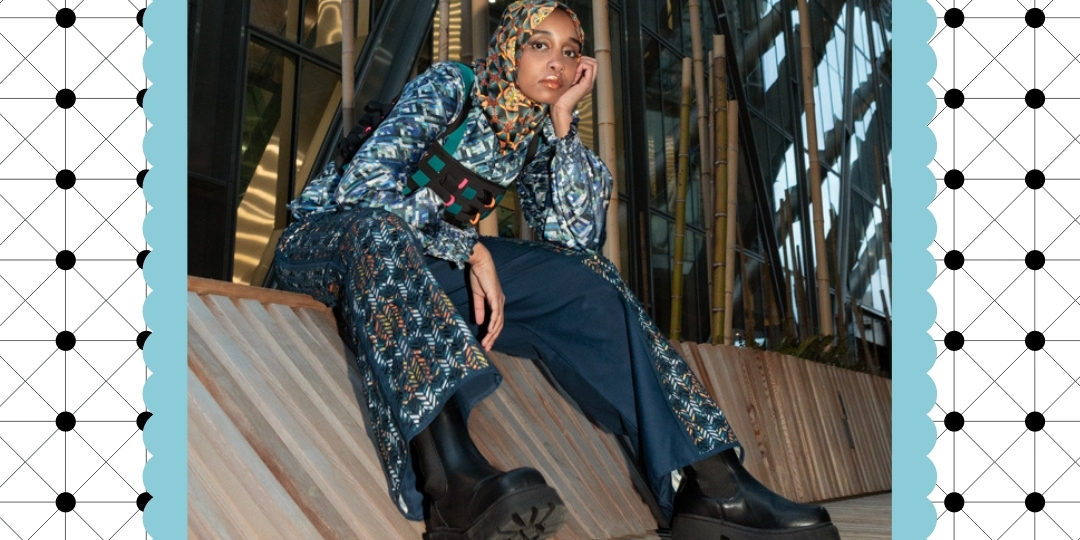
If you were perusing the home page of Vogue Italia’s website last week, you probably spotted an image of a hijabi model decked out in vibrant hues of orange and blue. The photograph shows a cutting-edge coat design by Hena Begum, a Bengali-British modest fashion designer, whose brand, Modestly, was featured in Graduate Fashion Foundation’s Digital Designer Profile at London Fashion Week last month. After a whirlwind week of showcasing at LFW and basking in the success of her incredible accomplishment, Hena spoke to modestish about her innovative weaving techniques, how Islamic architecture influences her latest collection, why the industry needs to become more inclusive, and the multidimensional meanings of modesty.
1. When did you launch your brand and what was the inspiration behind it?
I launched my brand in 2021. My inspiration behind the brand was to showcase modest fashion in a creative way. When looking into creating a modest fashion collection, I didn’t find a lot of experimental modestwear lines so I wanted to use my love for modest fashion and textiles to create a brand which gives women this option. I am also passionate about having a positive impact on diversity in the fashion industry and I want to create conversations through my work and launching a brand allows me to do that.
2. Describe your muse or the woman you design for:
My muse for my brand is Halima Aden, she radiates confidence and has this fun and quirky energy to her which is what I tried to portray through my collection. I would also say that the average Muslim women are my muses, as it’s important to me that women who choose to dress modestly still feel empowered when wearing my collection. Hence why I incorporated experimental designs and lots of textiles and prints to let women make a statement through their clothing.
3. Tell us about your latest collection, and where it’s available:
My most recent collection takes inspiration from Islamic architecture and Islamic art. The collection incorporates laser cutting technology and weaving as the key processes. A majority of the prints found in the collection are inspired by geometric prints found in mosques, whereas the laser cut designs were inspired by mashrabiyas; a traditional lattice window framework found in Middle East homes. At the moment my collection is available on Instagram but I will be making a website later on this year.
4. Define what modesty, as a word, means to you.
To me the word modesty can cover many areas of one’s life. When it comes to fashion, it’s a way I choose to dress and there’s a criterion that needs to be met. When it comes to everyday life, I think presenting myself in a kind manner would also be considered modesty, it changes depending on what aspect of my life I apply the word modesty to.
5. Would you say modest fashion is a “religious” movement, a “style” movement, or both/neither?
I think modest fashion is both a religious and style movement. There is a need for modest fashion by us women who choose to dress modestly but it is fueled by the idea of creating garments that are stylish and fashionable. We see this with today’s Muslim women where many of them create outfits that fit the modest fashion criteria whilst following the latest trends, which is what I think modest fashion is all about.
6. How has shopping for modest fashion changed over the past decade, in your experience?
In my experience modest fashion has changed dramatically over the past decade from not having modest fashion lines readily available to now seeing brands incorporate modest fashion collections. It just means that it is a lot more accessible to us women who don’t want to spend hours looking for garments that fit our needs and makes the experience of shopping a lot more enjoyable although not perfect.
hena begum
Also, trends like the oversized clothing trend makes it easier to shop for myself as a Muslim woman because I can easily find clothing that it much more suited for me.
7. Name a career highlight:
I think one career highlight would be my work being featured in a Vogue Italia’s article. This wasn’t something I expected to happen so quickly in my career but this was such an amazing accomplishment for me and I am so grateful for it.
8. The most memorable garment you ever designed:
The most memorable garment I designed was the printed jacket I created for my graduate collection. It was the most difficult to design and I had to revise the toile multiple times before creating the final version. I loved the idea of creating a garment that makes a statement and I think I accomplished that through this garment with the large weaving across the top, the geometric pattern and the bright coloured shoelaces.
9. One Instagram influencer you’d love to work with and why:
If I could work with an influencer I would love to work with Dina Tokio. I have followed her for years and have watched her style evolve. She was the first Muslim fashion blogger I came across and I think she played a role in me being comfortable as women who dresses modestly. I also think her impact on the modest fashion industry has changed the way we view modest fashion, where it now a lot more approachable and fashionable than it was previously.
10. Name one thing you’d like to change about the fashion industry.
One thing I would like to change about the fashion industry is the lack of inclusion and diversity. Although we are now seeing new designers who come from different backgrounds and walks of life creating amazing collections based off of their experiences, the fashion industry doesn’t have enough space for those of us who are creating designs for the minority, therefore cutting off the message we are trying to send and the conversations we are trying to create.
Featured image courtesy of Modestly. Photographer: Ashley Jang, Pedro Matos Makeup: Soda Eiyn Choi Styling: Keeley J Dawson Model: Samira Noor via Bame agency
Follow Modestly on Instagram here